
Retrofitting Doors for EAC
MAXIMIZING PROFIT WHILE MINIMIZING LIABILITY
When it comes to retrofitting door openings for Electronic Access Control (EAC), security, fire life safety and accessibility are of prime importance – followed by maximizing profit while minimizing liability. As a door professional, chances are that converting a door from Mechanical to EAC is not your first rodeo. This white paper is intended to serve as a primer for your reference, whatever your level of expertise, certification or experience is.
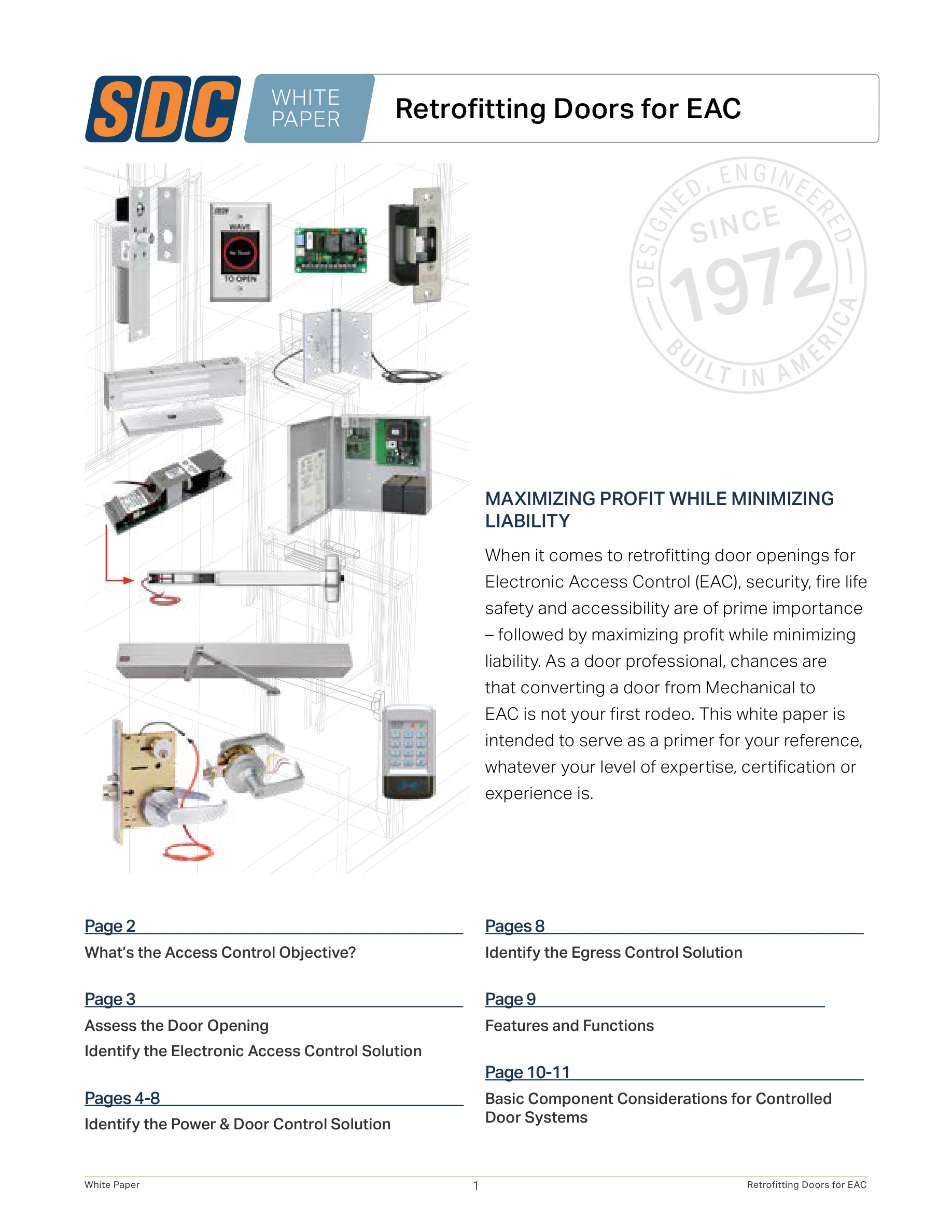
Table of Contents
What's the Access Control Objective?
First, you will need to understand what the access control objective is for the door, which usually falls into three main categories:
1. Security
Risk and asset management, personal protection and crime prevention are security considerations.
2. Life Safety
Fire, crisis management, crowd control, senior & infant protection, and hazardous material/contamination/disease control are typical life safety requirements.
3. Accessibility
ADA compliance, human & vehicle traffic control and the actual building function are accessibility concerns.
Consider the Profit Potential
Will your solution need to integrate with other technologies to maximize the benefit? Is there an opportunity for customer revenue beyond this door from options and upselling? Is this project right for you? With an understanding of EAC objectives, you can now apply them to determine the full profit potential for the EAC retrofit project.
Determining the best suited EAC hardware is central to your profit potential and requires a review of many factors. The accompanying considerations chart will guide you to some of the most important considerations.
Consider Liability Issues
Make sure you have identified the Code Compliance requirements specific to the EAC hardware and supply them to your customer. This information may be a deterrent to having an inspector reject the installation today, or at a later date when code changes take effect. This includes any performance certifications (ANSI/BHMA), lab listings (UL), and product or service warranties. Non-compliant components could lead to potential liability should a fire or life safety emergency occur in the facility where you installed them. Know and understand the products you are installing.
EAC PROFIT, LIABILITY & APPLICATION CONSIDERATIONS
Product Availability & Budget
- Timing/Delivery Affects Profits
- Within Cost Parameters
Retrofit Project
- Single or Multi-Door
- Standalone or Network Integrated
Life Safety Codes
- City & State Codes
- National Codes
- Local Jurisdiction (AHJ)
Type of Door & Frame
- Aluminum or Wood
- Off-Set or Center Hung
- Slide or Swing
Level of Security
- High Security - Failsecure
- Low Security - Failsafe
- Remote Monitoring Features
Aesthetics
- Concealed Locks
- Surface Mount
- Architectural Housing
- Availability Finishes
Before You Continue
With the proliferation of EAC hardware, products and systems on the market, there can be confusion as to their proper use and purpose. As a manufacturer, we have encountered many instances of misapplication in the field that deviate from the intended use and under or over-utilization of the Security, Life Safety and Accessibility features designed into these EAC solutions.
Make sure you understand how the EAC solution you have identified matches the service the door opening provides. Typical door opening service types might include:
- Public or private access
- Single or multi-directional traffic control
- Restricted access or egress
- Frequency of use
- Designated egress or fire exit door
- ADA accessibility
- Traffic categories dictating special consideration, and more
Industry Educational Recommendations
A great way to understand the right questions to ask is through continuing education courses offered by EAC manufacturers and online courses like these two from industry associations like DHI.org:
- "COR101: Fundamentals of Architectural Doors and Hardware"
- "COR102: Introduction to Building Codes"
Assess the Door Opening
If you do not already use some sort of door assessment checklist to help capture the necessary details for recommending an appropriate upgrade to the door, we recommend you do. SDC has developed a comprehensive Door Checklist in both interactive (sdcsecurity.com/Door-Checklist.htm) and downloadable (sdcsecurity.com/docs/door-checklist.pdf) versions. Or start with any trade association or EAC manufacturer you deal with to find an alternate resource.
The checklist will help you capture key door details that will figure into proper application and installation of an EAC component upgrade. Door handing, type of door and size, as well as type of door header and frame are important to confirm, as well as existing lock, hinge, door closer, ceiling type and height, distance from power supply, and more.
Identify the Door's Function
To best determine the appropriate retrofit solutions, you should identify the door's function by asking the following questions:
- What is the current door hardware function: storeroom, classroom, entry, or passage?
- Can existing hardware – like a mechanical exit device – be modified for electric operation or will it need to be replaced to operate in an EAC system?
- Is a field electrification kit available?
- If adding an auxiliary electrified lock, will it integrate with existing hardware like an electric strike or electromagnetic lock?
- Is a factory installed modification required to maintain a UL listing?
Fire Rated Openings
Fire rated openings are common in stairwell and elevator lobby door situations and will need to meet compliance with the Authority Having Jurisdiction (AHJ) who enforce the codes. Here, we recommend you are familiar with the NFPA 101 Life Safety code among others. Some key requirements are:
- Code requires self-closing & latching
- Free egress is critical for life safety
- Fail-safe electrified hardware is mandated
- Modifications to install hardware might require re-certification of door or frame
- Electrified hardware is typically tied into the fire system to release in the event of fire, power failure or other emergency
Identify the Electronic Access Control Solution
How will access be controlled?
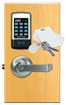
In the old mechanical days, staff employees were given a key to the facility and doors were manually unlocked during business hours. Today, an easy way to provide EAC now is by installing a keypad and/or reader at the door to control who can gain access by requiring a pin code, swiping or placing a credential near the reader, or using a smartphone. Keypads and readers come in standalone models or with outputs to connect them to an access control system – and usually unlock some type of electric locking hardware to gain entry.
There are also battery-powered Standalone Electric Locksets combined with keypads and readers that do not require hardwiring to an access control system. They are available in cylindrical, mortise or rim exit device configurations, as well as Bluetooth and software-enabled models. Wall mounted key switches may be used for some applications like roll-up door or automatic gate operation to control access vs. keypads and readers.

Does this door opening need to be ADA compliant?



People who are physically handicapped or disabled are guaranteed equality under the Americans with Disabilities Act (ADA), a civil rights law. Title III of the law covers Public Accommodations and is a directive to ensure accessibility within public buildings. Retail storefronts, office buildings, campuses and healthcare facilities typically need to meet ADA compliance at points of access and egress.
Public door accessibility for ADA applications can be met through the use of low energy automatic door operators. ADA compliant actuators – like wireless and hardwired Push Plate Switches to activate the door opener – can be used for handicap access and request-to-exit applications. Some ADA compliant actuators are wall mounted while others are placed within Bollard Posts at the entry or exit to the door. The use of Touchless Exit Switches to control automatic doors for a hands-free experience has increased dramatically with demands to increase public health and safety during the COVID pandemic.
Identify the Power & Door Control Solution
What lock will secure the opening?
Electric locking hardware comes in a variety of application configurations to meet local, regional and national fire and life safety code requirements. From electromagnetic locks, electric strikes, electrified locksets to electric bolt locks, and others, there's an EAC solution to meet just about any need to secure a door.



Professional Continuing Education
Thru DHI, the following two courses on hardware and electrified hardware applications are highly recommended:
- "COR117: Door, Frame and Architectural Hardware Applications"
- "COR133: Electrified Architectural Hardware"


How will the door be controlled?
Hardware control and door control modules are offered by many manufacturers to control separate electrified locking devices, multiple doors, relay operating and system modes for lock control, monitoring, communicating door and lock system logic. They are normally installed in the power supply cabinet and provide a centralized wiring location, simplify installation and provide easy troubleshooting.
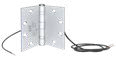
Power transfer devices are required to power EAC components and include power transfer loops, concealed power transfer hinges and devices.
Power Supply Considerations
Do not forget to consider the power supply itself. Door hardware and locksmith professionals should know that power requirements for EAC hardware is different from other systems such as CCTV. Access control systems require steady low-voltage DC current and generally draw higher current during access control-related events, such as when an electric strike is released.
Power Supply Evaluation Checklist:
- What power is required and what power is available (if retrofitting)?
- If retrofitting, what modifications have been made over the years to affect capacity?
- How old is the power supply? (If older than 10 years, replace it).
- Do all products really work together?
- What regional and national codes might be applicable?
- Does your AHJ require UL 294 compliance?
- How long must the system function after a power loss?
- Is a low-voltage license required in your jurisdiction?
What About PoE Solutions?
So far, our discussion has focused on retrofitting or upgrading a door opening for EAC without regards to whether it must integrate with a PC-operated access control system or network. Some of you may be adept in integrating a door opening with a larger enterprise EAC network through experience, training and/or familiarity with reselling or installing some of the many proprietary access control systems on the market today.
Some of you may feel you are the door expert, but not the IT and software expert. You may be reticent to take on jobs that can potentially open up a whole new bag of snakes from callbacks for software and hardware conflicts, incorrect settings, or even general liability for IT issues that may not be the result of your installation.
You have options. Consider online training courses in order to become more proficient in the best practices for integrating door openings into an access control network. Check out the Electronic Security Association at esaweb.org, SecurityCEU.com, or even online modules offered by many of the industry's manufacturers.
Power Over Ethernet (PoE)
As you learn and become more familiar with networks and access control, you still have some choices for integrating your door opening into an EAC system without being an enterprise IT expert. Leading among these alternatives are Power Over Ethernet (PoE) hardware and components that connect to an IP-enabled controller using the Ethernet cable that already exists in the facility - to avoid heavy cost commitments associated with complex, over-sized enterprise wide systems.
PoE solutions like these can be as simple as tapping into the nearest Ethernet connection to power and control door access via web browser and low-voltage access and egress devices. If you become comfortable at recommending and installing PoE solutions, you can carve out a niche serving the smaller company or single facility that doesn't require a full-blown, complex and expensive enterprise wide system.
IP-Based Door Access Controllers
There are also several manufacturers that offer IP-based door access controllers that are powered by Ethernet cables, connect to the existing network structure, and are browser-based – requiring no software to install. Simply plug the controller into a wired LAN connection and use the web browser on a computer or smartphone to setup and manage the system.
These PoE/IP-based controller solutions allow you to get in and out of a job quickly because time is money. Multi-door applications are also supported by several manufacturers, from simple IP-based door controllers in 2, 4, 6, 8 door configurations to controllers with optional expansion boards for additional door openings.
Installation Best Practices
As with any tenant improvement or low-voltage implementation via Ethernet cable, we recommend that installers are comfortable with Ethernet network best practices, and test any installation using an inexpensive Ethernet cable tester before startup. Also, by following industry standards – ANSI/TIA-1005-M.I.C.E and ANSI/TSI-569C.0 (cable lengths) – many issues can be eliminated that may be residuals of previous installations.
Single Door PoE Solution Example
Direct IP-Based Door Controller connection managing 1 door with browser-based setup.
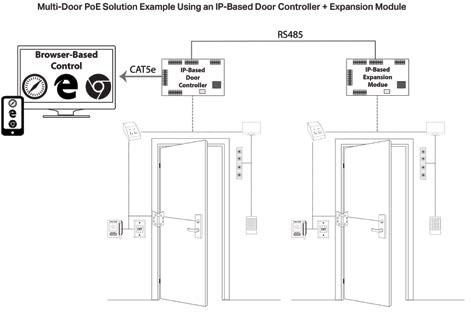
Multi-Door PoE Solution Example
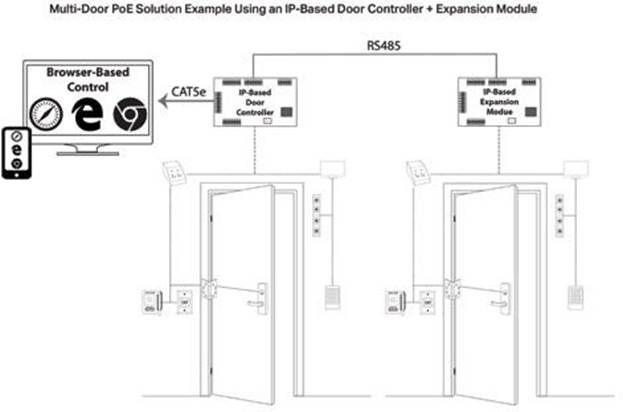
IP-Based Door Controller combined with RS485 expansion module for multi-door scale.
Identify the Egress Control Solution
How will I get out?
Key switch assemblies provide an economical method of providing authorized control for a variety of applications and new or retrofit construction. Most use U.S. standard, 1" and 1 ⅜" mortise key cylinders and interchangeable core cylinders to maintain compatibility with a new or existing facility mechanical key system. Many manufacturers also provide a variety of exit button and push button styles and contact configurations to fit several request-to-exit application needs. Additionally, wave-to-open switches and motion sensors provide hands free compliance and convenience for touchless applications using proven infrared detection technology.


Egress devices are designed for the release of electromagnetic locks and the activation of delayed egress locks installed on non-latching doors. Request-to-exit (REX) push bars provide uninhibited egress through access controlled openings equipped with electromagnetic locks, while eliminating the need for prior knowledge of egress operation and enabling egress with a single natural motion.
Electrified Exit Devices
Exit devices are an essential hardware component found in almost every building for safety and security. Electrified exit devices allow for greater control of the opening and can interface with other electronic equipment. They can either control the latch bolt of a device or control the locking of the operating trim.
There are two ways to control the electric locking and unlocking of the exit device:
- First Method (ELR): A solenoid or motor retracts the latch (Electric Latch Retraction – ELR) and holds it retracted or in the "dogged" position until power is interrupted. The door operates in a push-pull manner.
- Second Method (Operating Trim): Controls the operating trim, allowing the exit device to remain latched. The exterior lever, knob, or thumbpiece is electrically locked or unlocked for entry control in either failsafe or failsecure modes.

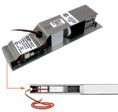
Electrified exit device manufacturers offer a variety of available trim options, as well as device types such as rim mount, surface vertical rod and concealed vertical rod. There are also cost-saving ELR Field Modification Kits available to convert existing mechanical exit devices to electronic, enabling electric access control and simultaneous latch retraction and dogging operation.
Features and Functions
What else do I need?
There are remote controls and annunciators designed to meet the demands of different control and monitoring applications without PC-based access control capability. They provide methods for central monitoring and control of openings in a facility as well as audible and/or visual status supervision and notification. They can include desktop modules with switches to release a single opening and LED displays to indicate door position or lock status.
Door Prop Alarms with timed delay, LED status display, and buzzer alarm are available to prevent leaving a door open beyond a specific time to alleviate unauthorized students or employees through a controlled door opening. Plus, there are a variety of electrified accessories and specialty items to enhance any EAC conversion solution, depending on the application.


Basic Component Considerations for Controlled Door Systems
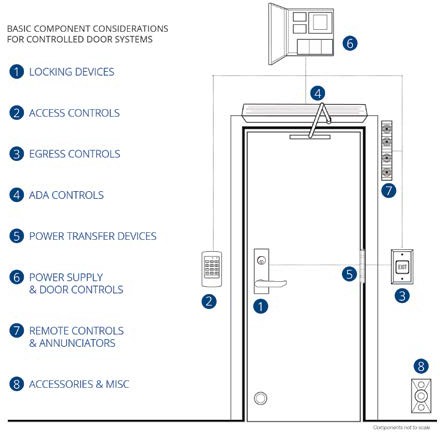
The graphic highlights the essential components that are normally recommended when preparing an upgrade. SDC provides compatible physical access and egress configurations for up to 100 or more doors to bridge the gap between traditional mechanical locks and digital networks.
2 Access Controls
3 Egress Controls
4 ADA Controls
6 Power & Door Controls
7 Remotes & Annun.
8 Accessories & Misc
1 Locking Devices
2 Access Controls
3 Egress Controls
4 ADA Controls
5 Power Transfer
6 Power & Controls
7 Remotes & Annun.
8 Accessories & Misc
Full icon set and links: sdcsecurity.com/products

For more information, access our Complete Component Considerations brochure online at:
sdcsecurity.com/docs/component-considerations.pdf
Want to learn more?
Sign up for our free Continuing Education class – "Door Openings and Access Control Hardware" worth 1 CEU – by sending an email request to:
sales@sdcsecurity.comWe'll notify you when the next online class is available or if the class is coming to a venue in your region.
Hopefully, this white paper has given you some practical insights for consideration when retrofitting a door for EAC that will help to minimize liability and maximize the profit potential for the installation.
Don't forget, industry associations like ALOA (www.aloa.org), DHI (www.dhi.org), ESA (www.esaweb.org) and others, have a wealth of information, tools and training to assist you in your electrified door hardware and access control projects. As always, consult your local Authority Having Jurisdiction (AHJ) for compliance requirements before starting any door installation project.